
The Bottom Left Trap
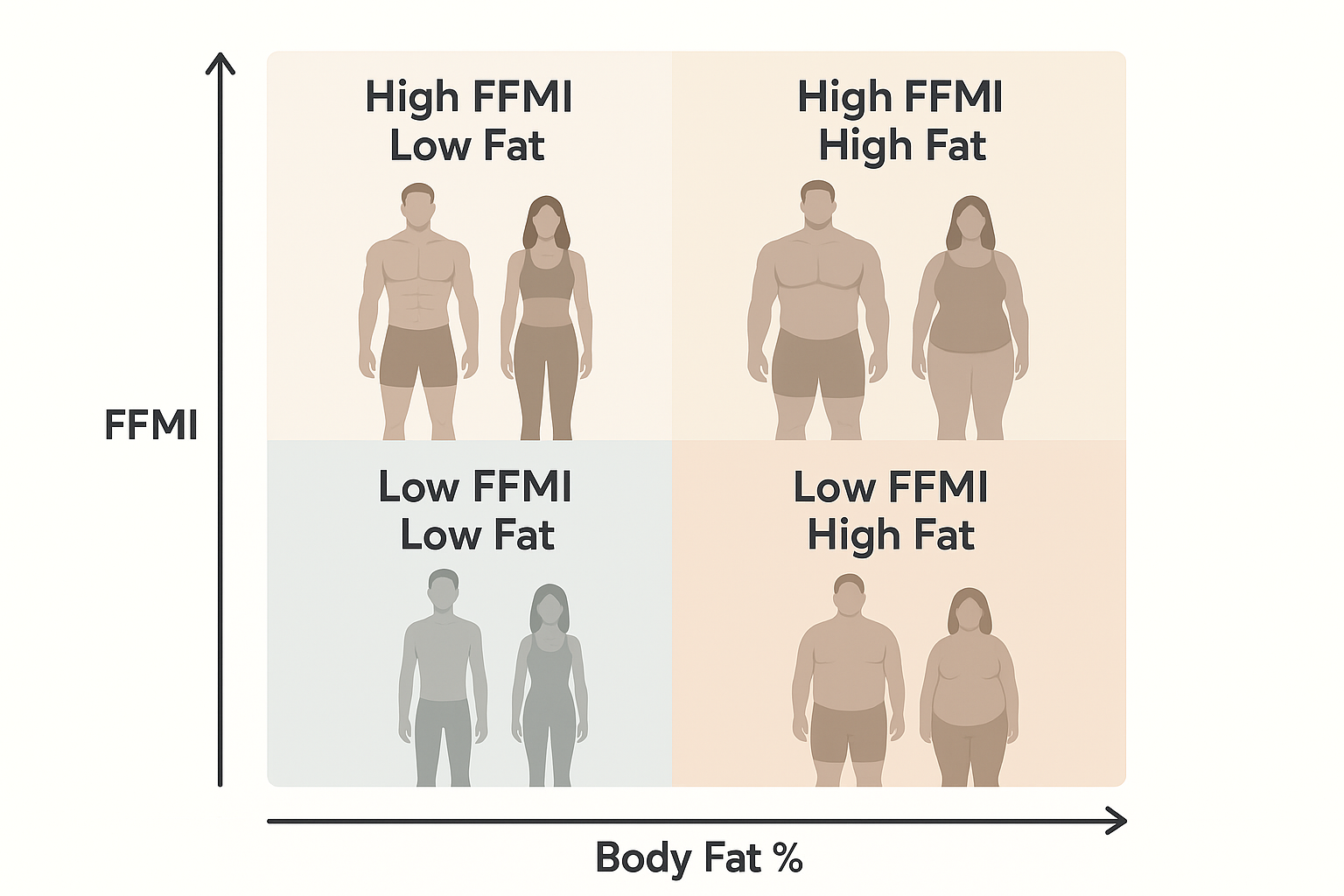
The Bottom Left Trap Quadrant
Read Time: 10 minutes
Author: Jamie Scott
Für eine deutschsprachige Version dieses Artikels klicken Sie hier.
Look at the diagram above. Four quadrants defined by two variables: Fat-Free Mass Index (FFMI) on the vertical axis, body fat percentage on the horizontal. Most people fixate on moving left - sometimes with the goal of increasing muscle mass, and sometimes not - but always with the primary goal of reducing body weight and fat at any cost. And that drive for weight/fat loss creates a trap that keeps people stuck in a cycle of metabolic suppression, increasingly restrictive eating, and diminishing returns.
Before we go further, an important clarification: This diagram is a heuristic tool, not a rigid categorisation system. The figures represent relative positions on a spectrum, not absolute ideals or fixed destinations. People exist across this continuum, and the boundaries between quadrants are fluid. The value of this framework isn't in precise categorisation, but in understanding the directional movement and metabolic consequences of prolonged restriction.
Don't get lost trying to identify exactly which quadrant you're in - focus instead on understanding the patterns and trajectories described here.
Here's the common pattern: Someone decides they need to lose weight. They cut calories (typically through cutting carbs and/or various forms of fasting), increase cardio, and wait for the scale to drop. In the short term, the weight drops, and they start tracking to the left on our diagram above, sometimes toward the top left, and sometimes toward the bottom left. But this is only in the short term.
Here's what almost no one tells you: very few people can maintain the left-side states without increasing levels of restraint and obsession. It starts as dedication and discipline. It becomes measuring everything, avoiding social situations, anxiety around any deviation from the plan, constant body checking. And at a certain point, you're no longer "being good with your diet", you're in disordered eating territory. The level of control required to stay left, particularly in extreme cases of the bottom left quadrant, is the disorder.
“Athletes viewed hunger, fatigue, and social sacrifice as a marker of dedication and success, “You have chosen to do something extreme with an extreme adventure. You can expect extreme challenges”.
This cultural framing of suffering obscured early signs of REDs, normalizing disordered behaviors and physiological disruptions, including loss of sleep, strength, reproductive function, and cognition function. Negative outcomes were framed as personal weakness or lack of commitment rather than signals of physiological harm, “I couldn’t tell him that I was struggling because I didn’t want him to pull me out of the program and say, Well, you don’t have what it takes.””
The Fear That Keeps You Stuck
The irony is brutal. Among their many reasons, people are often so terrified of becoming the figure in the bottom right quadrant - higher body fat, low muscle mass - that they engage in the exact practices that make that outcome more likely over time. Each cycle of severe restriction decreases muscle mass and suppresses metabolic function. Your thyroid output downregulates. In lean individuals, sex hormones drop. Leptin sensitivity deteriorates. You're not just losing fat, you're dismantling the very systems you need to build and maintain muscle tissue.
And when that restriction inevitably fails (because you can't live like that forever), where do you end up? Most usually start rapidly tracking toward the bottom right, and become stuck fighting ever harder to cling to the bottom left.
Here's the thing that people desperately attempt to avoid hearing: if you're in the bottom left quadrant due to years of restrictive practices and metabolic suppression, it is incredibly difficult to transition directly from there to the top left. You can't carefully recomp your way there whilst maintaining low body fat.
Theoretically you can: if your entire life is structured around it, if you have no career demands, no family obligations, no stress, perfect sleep, and the ability to maintain surgical precision with your nutrition and training for months (and probably years) on end. For everyone else living in the real world, for people with jobs and relationships and the psychological scars of years battling this cycle, that path rarely exists.
The Only Way Through
The path from bottom left to top left, by necessity, goes through top right. You have to regain body fat. You have to create an internal environment that supports muscle growth. You cannot build tissue in a suppressed metabolic state. Your body won't partition nutrients toward muscle growth when it's still in energy conservation mode.
This fact is most observable in bodybuilding. Competitive bodybuilders go through extremely restrictive diets to achieve stage-ready conditioning. They're (relatively) in the bottom left at competition: low body fat, but also reduced muscle mass from the dieting process (by the time a competitive bodybuilder is on stage, they have lost a considerable amount of muscle mass relative to their peak just prior to beginning their cut).
Their recovery requires them to regain significant body fat to reset their metabolism and rebuild muscle tissue. They cycle to the top right before being able to move back toward the top left. Seasoned bodybuilders understand this cycle is necessary and temporary. They accept that post-competition rebound isn't failure, it is physiological reality. They have a framework that separates their competition physique from their day-to-day living physique. They know the bottom left isn't sustainable.
But understanding doesn't make it easy. A recent qualitative study of competitive physique athletes (1) captured the experiences of those who undergo prolonged energy restriction for competition and navigate post-competition recovery. Even seasoned competitors described significant psychological toll. As one athlete put it:
“Just going from where you look in the mirror … your weight dropping every day … you’re skeletal, too thin, but it’s normal … all of a sudden you put on 1 kilo, and it feels like you put on 10.”
Yet these athletes, at least the seasoned and experienced ones, have developed a framework for accepting temporary harm. One explained: "When I decide to compete in bodybuilding, I am making an intentional departure from certain aspects of my health."
Another framed it as: "I can accept being unhealthy because it's such a short period of time. For me, it was always, 'How far can I push this?' And then, the moment I've done it, let's get out and get back to being healthy."
They accept the temporary compromise because they have a framework for it - competition preparation is a bounded period of intentional metabolic stress, followed by deliberate recovery.
But the average person? They interpret any fat gain as failure. They panic back into restriction. They think the bottom left should be their permanent everyday state. That delusion keeps them trapped. And even when their body tracks to the right, rather than continuing on with a view to coming out the other side (top left), they keep trying to drag their body back down.
This is the bottom left trap.
The Timeline No One Wants to Hear About
Let's be upfront about this: we're not talking about six weeks.
We're probably not even talking about six months.
If you've spent years suppressing your metabolism through restrictive practices, recovery will likely take 18-24 months, possibly longer. The timeline depends on how long you've been in restriction, your age, and individual factors. Those fighting significant muscle loss on top of metabolic suppression will need more time and patience.
You'll spend a good portion of that time in the top right quadrant, carrying a level of body fat you're uncomfortable with. But during that time, you'll be improving energy, sleep quality, training performance, recovery capacity, and lean mass. Your metabolism will improve. Hormones will normalise.
You'll be creating the foundation that actually allows a more suitable and sustainable leanness later.
The alternative? Stay stuck.
Keep fighting ever harder to stay in, or get back to, your desired ideal on the left. Watch the restriction escalate. Watch the anxiety increase. Watch your muscle mass decline further and your metabolic capacity diminish. That's the real timeline - years more of the same cycle, with diminishing returns each time.
There's no sugar coating this. It is what it is. If you've been battling this for years already, what's another 18-24 months if it actually addresses the problem? Compare that to five more years of the same destructive cycle.
The Psychological Barrier
Here's perhaps the biggest obstacle: even when people intellectually understand they need to eat more and accept temporary fat gain, the fear is overwhelming. Years of both conditioning and self-loathing have taught them that fat gain equals failure, that they should always be pursuing less, that their worth is tied to the number on the scale moving down.
Even athletes who intellectually understand the necessity of weight restoration struggle with fear and guilt. In the same study of physique athletes (1), one competitor described how post-competition anxiety spiraled into disordered behavior:
“I was extremely scared of seeing my body fat increase … I would just taste a food, and then one bite would turn into 2, 3, 4, and then I’d be like f***, I’m just going to eat the whole thing and then go make myself sick. So, that’s when the purging came into play … and when I realized I had a problem.”
This is the reality: the psychological difficulty of moving through the top right quadrant can trigger or worsen disordered eating patterns, even in those who supposedly "understand the process."
People need emotional permission (from themselves, not anyone else) to move through to the top right quadrant, not just information about why it's physiologically necessary. They need to understand that staying in the restrictive mindset longer causes more damage than the physical detour through higher body fat would.
You can rebuild metabolism and muscle. But undoing years of food fear and body dysmorphia? That takes much longer.
The obsession required to maintain the leaner states of our quadrant isn't a side effect of that body dysmorphia - it is the mechanism for it.
And that psychological damage delays recovery more than any physical detour would.
The Choice
So here's where you are: you can commit to the actual process - accepting that recovery from metabolic suppression requires a temporary move in what feels like the wrong direction. You can spend the next 18-24 months (and potentially longer) rebuilding yourself physiologically and psychologically, knowing you'll carry more body fat than you want for a significant portion of that time, but that you're moving toward genuine, sustainable health.
Or you can acknowledge you're not ready for that yet.
Both responses are valid.
What isn't valid is continuing to believe there's a shortcut that lets you skip the top right quadrant and go straight from bottom left to top left. That path doesn't exist for most people with years of restrictive patterns behind them.
The timeline becomes more critical as you age. Each year spent in the restriction cycle is a year of muscle loss that becomes progressively harder (though not impossible) to reverse. The rebuild takes longer and requires more patience. But the alternative - continuing the cycle - only makes the eventual recovery less likely and comes with a raft of later life health consequences, such as osteoporosis.
The Truth About Sustainable Body Composition
Here's what a moderate, sustainable variant of the top left quadrant actually represents: adequate muscle mass with reasonable body fat levels, achieved and maintained through practices that support metabolic health. You train consistently. You eat enough to support that training and recovery. You have energy for your life. You're not anxious about food. You can go to dinner with friends without panic.
That's what people actually want. Not the bottom left, which requires increasing psychological distortion to maintain. Not the desperate attempt to stay lean through ever-escalating restrictions.
But you cannot build that from a suppressed metabolic state.
You cannot create it by continuing the same restrictive practices that caused the problem in the first instance.
The only path forward goes through acceptance. Acceptance of the timeline, acceptance of the temporary body composition changes, and acceptance of the fact that there are consequences to years of metabolic suppression and you have to work through them.
The choice is yours, but the timeline is largely non-negotiable. Your body has its own requirements for recovery, and no amount of willpower or restriction will change them. The only question is whether you're ready to accept that and commit to the process, or whether you'll spend more years fighting a battle you cannot win.
Our diagram isn't just about body composition. It's a map of the choices available to you and their consequences. Most people have been trying to force their way bottom left for years. Perhaps it's time to consider moving up instead, even if that means temporarily moving to the right first to get there.
Reference:
Thomas EA, O'Neill B, Pelly FE, Thurlow J, Slater GJ. Navigating nutritional extremes: a qualitative exploration of physique athletes' perspectives on low energy availability and recovery. Journal of the International Society of Sports Nutrition. 2025;22(1):2576238. doi:10.1080/15502783.2025.2576238
