
The Games We Play

When you are underfuelled but will do anything to show that you aren’t
Read Time: 10 minutes
Author: Jamie Scott
It's a common pattern. Someone posts their workout meals with pride - perfect timing, appropriate carbs, maybe even calculated to body weight. They're trying. They understand that fueling matters.
Except that perfect meal is often an island in an ocean of underfueling. That single session gets all the attention while the daily deficit continues, the rules get stricter, and the resistance to change grows.
I see this constantly in individuals who've come from a history of restriction. Often women. Often very intelligent, educated people who understand nutrition - at least intellectually. Sometimes nutrition professionals themselves. And the pattern is always the same: token fueling masking continued restriction, dressed up in seemingly valid rules and endless questions.
What's actually happening?
The Proper Order
Building nutrition competence happens from the bottom up. You master energy balance first. Then macronutrient distribution. Then micronutrient adequacy. Only after the foundation is solid do you start playing with nutrient timing, periodisation, and supplements.
This isn't arbitrary. The foundation determines whether the advanced strategies even work. Timing your carbohydrates perfectly around training means nothing if you're not eating enough carbohydrate overall. Fasted training adaptations can't occur properly if you're systematically underfuelled.
But here's what I see: people trying to operate at the top of the pyramid while the foundation crumbles.
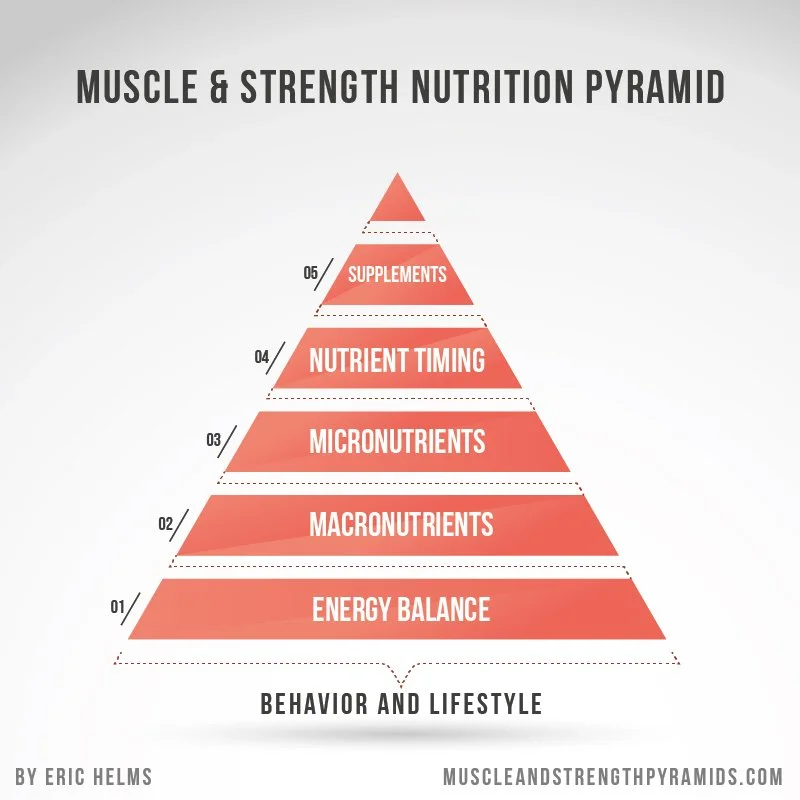
Credit: Dr Eric Helms, PhD
Performance That Performs Nothing
Let’s use the example of an individual undertaking athletic training (perhaps even training for an event), 5-6 sessions per week. They're eating 4-5g carbohydrate per kilogram body weight daily when their training outputs demand at least 6-7g/kg. That's at least 50-75g short every single day.
But they'll show the one meal where they got it right. “Look, I’m fuelling!”
And of course, this is great, and I don’t ever want to give the impression that this effort should be diminished. But when zooming out and looking at the bigger picture, this is display is performative compliance. One well-fuelled session doesn't compensate for ongoing and systematic underfuelling.
It's like claiming you're managing your finances well because you put €20 in savings while spending €100 more than you earn daily. The selective focus allows them to maintain an identity as "someone who fuels properly" without actually eating enough.
Strategic Signaling
The signalling is often very specific. Gummies during strength training. Cake stops on long rides. Pre-workout carbs posted to social media. These aren't random choices - they're specifically the permission foods. The things that would have been most restricted before.
Consuming them becomes proof of progress, proof of recovery, proof of change.
"Look, I eat carbs now. I have gummies during training. I stop for cake. I'm not that person who restricted anymore."
But if the gummies happen while main meal carsb are skipped, if the cake on the ride replaces an actual meal rather than supplementing baseline intake, if the pre-workout snack also functions as breakfast, then it's not actually change. It's restriction with different aesthetics.
The symbolic foods provide protection too. "How can you say I'm still restricting when I'm eating gummies? When I stopped for cake?"
The performative consumption becomes a shield against accountability.
And there's something particularly clever (even if unconscious) about choosing these specific foods for the performance. They signal freedom and flexibility - "I can eat sugar! I'm not afraid of simple carbs!" - while the overall pattern remains controlled and restricted. They get credit for the symbolic without actually meeting the substance of their needs.
Rules That Uphold Restriction
Remember, these individuals often come from a background of dietary restriction and disordered eating. Pay attention to the rules they create around fuelling their training. They're often advanced sports nutrition rules and practices, but applied arbitrarily and almost always out of context for the individual:
“I only need to fuel sessions over 90 minutes.”
”I don’t need carbs for short interval sessions.”
”I don’t to eat during strength training sessions.”
”I don’t need to fuel morning sessions if I eat breakfast straight after.”
”I don’t fuel evening workouts because I’ll eat dinner after.”
”It’s a recovery day, so I don’t need to eat as much today.”
These rules aren't based on the individual’s actual context and needs. They're structures designed to restrict energy intake while still appearing reasonable. “I do fuel my training sessions!” [caveat: as long as they are over a certain duration]
Here's the reality: when you're systematically underfuelling, every session matters to your overall energy availability. If you're eating enough overall (truly enough), then yes, you can be more selective and apply more advanced techniques, such as periodised nutrition, carb cycling, etc.
But when you're running a daily deficit while training 4-6 days per week, all sessions need fuel.
These rules around fuelling serve another purpose: they maintain control.
For those with a history of dietary restriction that was severe enough to cause the loss of their menstrual cycle, food is maintained as a primary control mechanism. These arbitrary and decontextualised rules around when to eat and how much create feelings of control and safety. Letting them go feels like losing structure entirely. But these rules ultimately aren't protecting the individuals, they're perpetuating their problem - chronic underfuelling.
The Question Cascade
This pattern reveals the resistance most clearly. As a Nutritionist and Coach, I might have identified the underfuelling issue and have suggested practical solutions: foods with a higher carb density, increased eating frequency, use highly palatable foods and sports products to bypass satiety (lollies, gels, etc.), and drinking carbs rather than eating them.
Then the questions begin.
“But which drink?”
”How much exactly?”
”When should I have it?”
”What if it upsets my stomach?”
”Won’t that spike my blood glucose/insulin/cortisol?”
One question after another after another. Each sounding reasonable in isolation. And don’t get me wrong - asking questions is to be encouraged.
But taken together, they form a pattern: endless information-seeking designed to delay action.
This pattern is particularly striking when it is observed in those people with nutrition qualifications or significant training experience. These are professionals, coaches, and experienced athletes who already know the answers (or they know how to find them). The same person who can cite studies about carbohydrate needs suddenly has endless questions about basic implementation. The same person who says they understand energy balance claims they don't know how to eat more.
Knowledge is applied when it supports current behaviour and questioned - repeatedly - when it challenges it. It's not that they don't know enough. Knowing isn't the problem.
The questions aren't about seeking new information. They're about managing cognitive dissonance - the conflict between understanding intellectually that the need to fuel more while emotionally resisting the actual behaviour change.
The questions create the appearance of engagement in the coaching process without requiring action. They're buying time, seeking permission to continue as-is, or searching for reassurance that they don't really need to change.
When someone intelligent and educated asks question after question about basic implementation, they're not confused. They're resistant.
Competence Provides Cover
This is the mechanism that makes the whole pattern work. Competence at the advanced levels actually provides cover for non-compliance at the foundation.
Someone demonstrating they understand nutrient timing and advanced protocols is signalling competence. They're educated, sophisticated, engaged with the science. That competence becomes proof they know what they are doing. It lets them maintain an identity as someone who's engaged with their nutrition seriously.
And that identity protects them from the simpler, more uncomfortable truth: they're still restricting, just with more sophisticated language around it.
If they're competent with complex strategies, then their struggle at the foundation can't possibly be simple restriction or avoidance. It must be something genuinely difficult. Some implementation detail they haven't figured out yet. Some individual factor that makes the basics specifically harder for them.
The competence is being deployed strategically. They engage with complexity in areas that don't threaten their restriction (timing protocols, supplement choices, advanced nutrition periodisation strategies), which allows them to avoid compliance in the one area that does threaten it: eating enough.
The Social Element
There's often social reinforcement that goes unacknowledged. Individuals often won’t fuel their training when they are with others who seemingly set the social standard and whose judgement they fear. If it's not common practice in their particular group, even when their own individual context demands it, they do not want to be seen fuelling when others aren't.
I’ve seen this particulary in cycling circles, where men and women of a certain vintage claim that all you need is water for rides spanning multiple hours - especially if you have some weight to lose anyway. The culture in these individuals and groups doesn't normalise fuelling early and frequently, and there will be anything from comments made about why someone is eating, to their body weight and appearance, to a refusal to stop.
The fear of judgment among individuals embedded in these social groups is real and reinforces restriction even when they intellectually know better.
The Cost Remains the Same
Every session in deficit digs a slightly deeper hole. Perhaps not ones as deep as one might have been previously in (which itself can perpetuate the problem - “this isn’t so bad, I’ve been worse.”
Performance still plateaus because you're not adapting to training, you're just surviving it. Sleep still suffers due to the low level stress.
Hormonal function remains compromised. If you've lost your period from previous underfuelling, you might find yourself with a wonky anovulatory cycle and teetering on the edge of losing it altogether once again.
Your relationship with food stays dysfunctional. Every meal remains a negotiation. Restriction has shifted from total to fuelling is only permissable when tagged to certain types of training sessions of certain durations. And perhaps in certain company (but not others).
Sports nutrition stays in the "threat" category rather than becoming a neutral tool.
And perhaps most significantly: the pattern self-perpetuates. Underfuelling impairs performance, which creates more stress, which reinforces the need for control, which maintains the restriction.
The Harder Truth
This pattern persists because the historical restriction served a purpose. Control when other things felt uncontrollable. Clear rules in an uncertain world.
Letting it go isn't just about eating more calories or carbohydrate. It's about losing a coping mechanism, no matter how maladaptive it actually is.
That's why the resistance is so strong even when someone intellectually understands what needs to change.
If this is you, you probably need support beyond information. A coach who calls out the patterns (with empathy, of course), and who won't accept the performance of compliance while the underlying restriction continues. A psychologist who understands disordered eating and exercise dependence.
Because you can keep asking questions, maintaining rules, and showing the one good meal while maintaining the overall deficit.
Or you can acknowledge the pattern, accept it's no longer serving you, and do the uncomfortable work of actually changing.
Not performatively. Actually changing.
Stop hiding behind rules that protect restriction. Start fuelling your training. All of it. Properly. Even when it's uncomfortable. Even when it challenges your identity. Even when it feels like too much.
Because the alternative is staying exactly where you are, playing games with yourself while calling it progress.
